
US buyers researching Peru real estate in 2026 need three answers before they wire a dollar to Cusco or the Sacred Valley: can they legally own the property, is the title clean, and what does closing actually cost beyond the sale price.
- US citizens can own Peru real estate outright with the same title rights as Peruvian nationals, except within 50 kilometers of an international border.
- SUNARP registration and a notario público closing are required steps, not optional add-ons, on every legitimate Peru property purchase.
- Perfecto Homes Real Estate works bilingual title checks and closings for US buyers in Cusco and the Sacred Valley.
- Budget for the Alcabala transfer tax and PEN/USD currency swings before you make an offer, not after.
Why Peru real estate matters for US buyers
Cusco and the Sacred Valley pull a steady flow of foreign buyers because the region sits on the route to Machu Picchu, which keeps short-term rental demand active year-round. That tourism traffic is exactly why land and hospitality property in the Sacred Valley get priced and marketed differently than a plain residential lot in Lima or Arequipa.
The legal barrier for US buyers isn't ownership rights — Peru's constitution grants foreigners the same property rights as citizens outside restricted zones. The barrier is language and process: notarial deeds, SUNARP filings, and municipal tax registration all run in Spanish, through a bureaucratic sequence most first-time foreign buyers have never touched. Working through Perfecto Homes Real Estate closes that language gap without changing the legal steps you still have to complete.
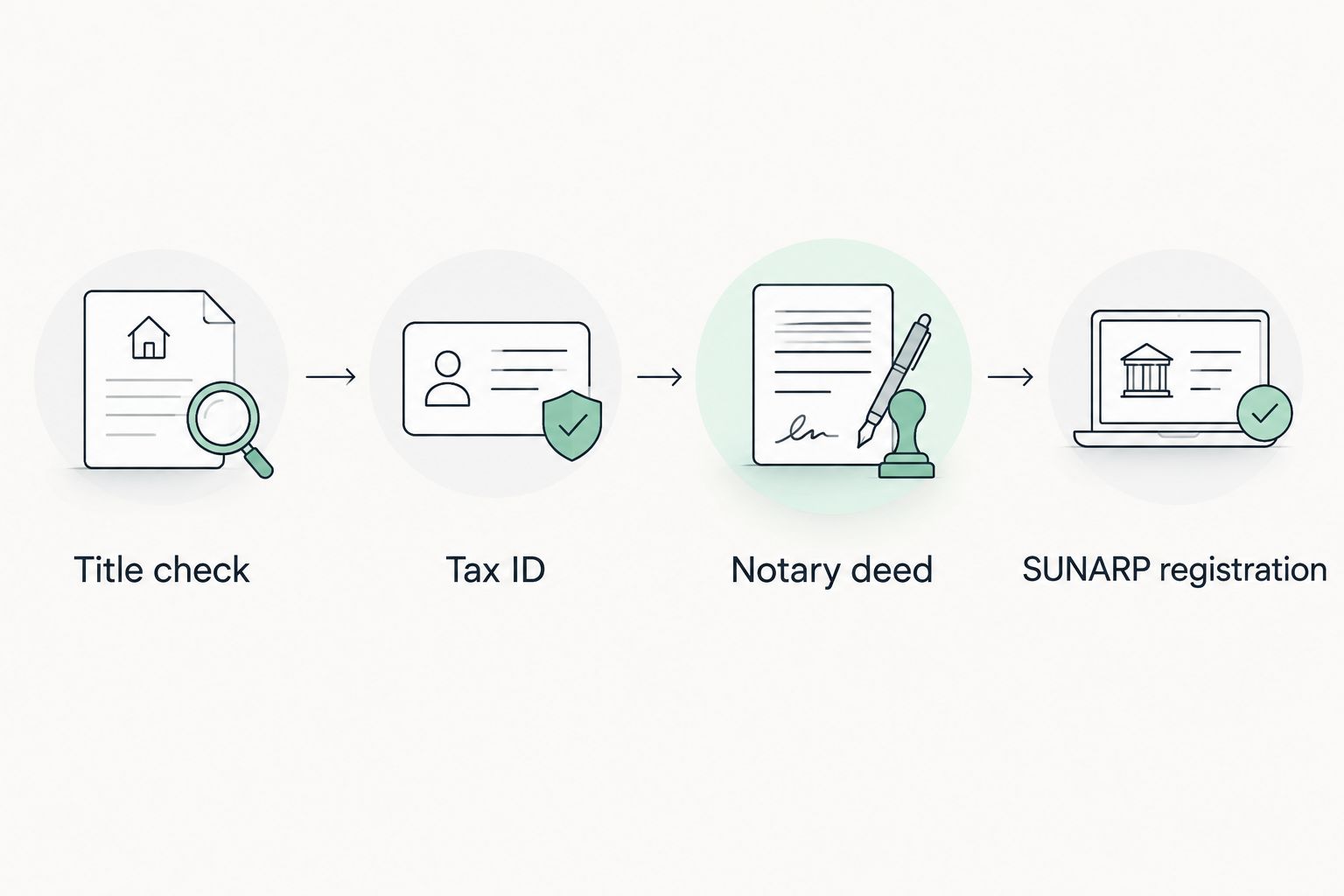
Steps to buy Peru real estate as a US citizen
Confirm the property sits outside Peru's border restriction zone
Peru's constitution (Article 71) bars foreigners from owning land within 50 kilometers of an international border without special presidential authorization. Rule this out before you get attached to a listing.
- Pull the property's exact coordinates and measure the distance to the nearest border.
- Ask the seller's notary for written confirmation the parcel isn't inside a restricted zone.
- Rule out mining or archaeological concession overlaps, common on rural Cusco land.
- Cross-check any "buildable" land claim against the municipal zoning file, not just the seller's word.
Verify the title through Peru's Public Registry
The partida registral, held by SUNARP, is the only document that proves who legally owns a property in Peru.
- Request the partida registral directly from SUNARP's portal or a Cusco branch office.
- Confirm the seller's name matches the registered owner, with no active liens attached.
- Check for unresolved inheritance claims, common on multi-generation family land in the Sacred Valley.
- Hire an independent Peruvian attorney to review the partida separately from the seller's own notary.
Get a Peruvian tax ID and decide how you'll move money
- Apply for a RUC through SUNAT, Peru's tax authority — most notaries require it to process the transfer.
- Open a Peru-based bank account or use an escrow service that can receive USD wires and convert to soles.
- Track the PEN/USD exchange rate for weeks before wiring; Peru's sol moves with copper and mining cycles.
- Confirm your US bank's wire limits and reporting rules for international real estate transfers.
Budget for closing costs beyond the purchase price
- Add Peru's transfer tax, the Alcabala, into your total budget — it's typically owed by the buyer.
- Factor in notary and public registry fees charged separately from the sale price.
- Set aside funds for certified translation of any English-language documents the notary requires.
- A bilingual, US-licensed brokerage cuts the back-and-forth between an English-only buyer and a Spanish-only notary, but it doesn't replace the independent attorney review from the previous step.
Close with a notario público and record the transfer
- Sign the minuta (private purchase agreement), then the escritura pública (public deed), in front of a Peruvian notary.
- Confirm the notary submits the deed to SUNARP — that filing is what actually transfers legal title, not the signature.
- Get a certified copy of the registered deed before wiring the final payment.
- Request the updated partida registral showing your name as owner, typically available weeks after filing.
Plan for ownership costs after closing
- Register for the Impuesto Predial, Peru's annual municipal property tax, with the local municipality.
- Set up a local property manager if the purchase is a Sacred Valley rental aimed at tourism traffic.
- Budget for currency conversion every time rental income moves back to US dollars.
- Keep your RUC and local tax filings current even if you don't live in Peru full-time.
“Skip the 50-kilometer border zones and the ownership question in Peru turns simple: US citizens buy with the same title rights as Peruvian nationals.”
Comparing your options for buying Peru real estate
| Option | Best for | Key limitation |
|---|---|---|
| Buy directly as an individual foreign national | A straightforward home purchase in Cusco or the Sacred Valley | You handle Spanish-language paperwork and notary logistics yourself |
| Buy through a Peruvian corporate entity (S.A.C.) | Investors buying hospitality or multi-unit property | Adds incorporation and annual filing on top of the purchase itself |
| Work with a bilingual, US-licensed brokerage | US buyers who want English-language guidance through the Peruvian process | Doesn't replace the independent attorney title review you still need |
| DIY with a local attorney only, no broker | Buyers already fluent in Spanish and familiar with SUNARP | No help sourcing or vetting off-market land and hospitality listings |
Talk through a Cusco or Sacred Valley purchase
Bilingual guidance on title checks, closing steps, and costs.
Common mistakes US buyers make with Peru real estate
- Wiring a deposit before SUNARP confirms clear title, then discovering a lien attached to the property.
- Treating a compromiso de venta (promise of sale) as if it were a registered deed.
- Ignoring the 50-kilometer border rule on Sacred Valley land marketed as "buildable."
- Treating notary and Alcabala costs as an afterthought instead of budgeting for them upfront.
- Skipping the RUC application, then hitting delays wiring funds through a Peruvian bank at closing.
FAQ
Can US citizens own property in Peru?
Yes, US citizens can own Peru real estate outright with the same title rights as Peruvian nationals, except within 50 kilometers of an international border where special authorization is required.
Is buying real estate in Cusco safe for foreigners?
It's safe when the title is verified through SUNARP and a notario público handles the closing; the risk sits in skipping that verification, not in foreign ownership itself.
What is the 50-kilometer border rule in Peru real estate?
Peru's constitution (Article 71) bars foreigners from owning land within 50 kilometers of an international border without special presidential authorization. It rarely affects Cusco or Sacred Valley properties but should be checked on rural parcels.
Do you need a Peruvian tax ID to buy property?
Most notaries require a RUC, issued by SUNAT, to process a foreign buyer's transfer. Get it before you're ready to wire funds, since it can add lead time.
Is Peru real estate a good investment in 2026?
Sacred Valley and Cusco properties benefit from steady Machu Picchu tourism traffic, which supports rental demand, though returns depend on the specific property and management setup.
How is property registered in Peru?
Title transfers through a notario público who signs the escritura pública and files it with SUNARP, Peru's Public Registry. Registration there, not the signature, is what makes ownership legal.
Can you get financing as a foreign buyer in Peru?
Financing options for foreign buyers are limited compared to US mortgages; most Peru real estate purchases by US buyers close in cash or through wired funds.
What are Sacred Valley properties like compared to Cusco city?
Sacred Valley properties tend to be land and standalone homes tied to agriculture or tourism, while Cusco city properties skew toward urban homes and hospitality units closer to the historic center.
One last thing
Peru's ownership rules are more direct than several of its neighbors: no trust structure, no local partner requirement, just a clean title check and a notario público closing. The paperwork sequence is what trips up US buyers, not the ownership law itself — get the SUNARP check and the RUC application done early, and the rest of the process moves the way it's supposed to.